Made for Maharajahs: the pearl carpet of Baroda
The most incredible carpet ever created by human hand is the famous Pearl Carpet of Baroda. It gets its name from the Maratha Princely State of Baroda, one of the four Princely States of the Maratha Confederacy, that was ruled by the Gaekwar dynasty since 1740. The carpet was made in 1865 and it took embroiderers and jewelers more than three years to create this masterpiece. The then Maharajah of Baroda, Gaekwar Khande Rao, ordered the carpet to fulfill his vow to cover the tomb of the Prophet Muhammad at Medina.
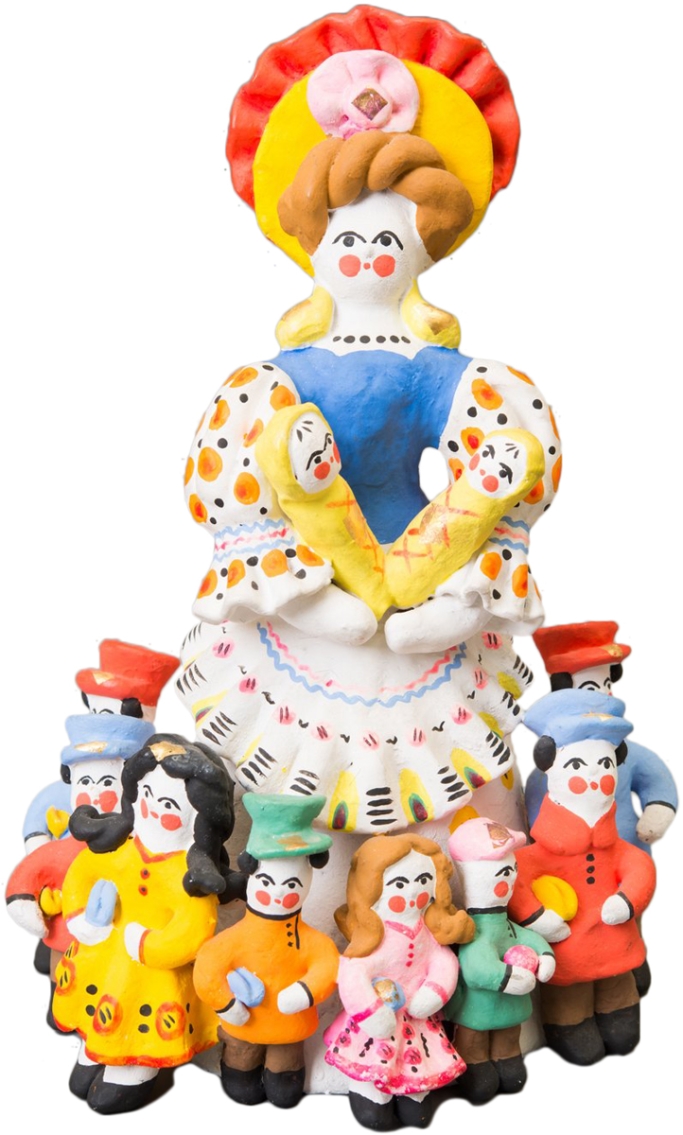
Folk clay toys from Russia
Mother with many children Dymkovo doll, 1960-70s, All-Russian Decorative Art Museum, MoscowPeranakan beadwork
Souvenirs from Vietnam: pottery
Though not famous for its high quality, Vietnam ceramics nevertheless are creative and have a sort of rustic beauty different from that of the carefully refined ceramics from some other countries. There is an air of innocent carelessness about them as if the craftsmen who produced them were quite liberal in their creation not relying too much on the rules of symmetry and decoration.
Gem carved sculptures from Hoi An museum
Happy Buddha, garnet
On a picturesque and crowded with tourists street of the Ancient Town of Hoi An there is a small but interesting museum, the Gemstones Art Museum. It was founded in 2013 by a Vietnamese passionate collector. The museum's exhibition is divided into two sections: one showcases natural gemstone crystals and uncut stones and at another more than two hundred pieces of precious stone sculpture are displayed. In terms of quality and rarity of the stones, the variety of the carvings represented the collection has no comparison in Vietnam. Visitors have a unique chance to get to know and enjoy the great artistic and manual skills of Vietnamese craftsmen. Here are a few examples of the gem carving from the museum's collection
Crafts of Central Asia: ganch carving
Detail of the ganch wall decoration, the Throne Hall, Khudoyar Khan Palace, Kokand, Uzbekistan
Anyone who has not been to Central Asia is hardly likely to know the meaning of ganch. If one explains what ganch is it may seem highly prosaic: it is neither stone nor clay but something in between. It is obtained by firing a rock containing gypsum and clay and grinding it into a powder which is then mixed with water and a solution of vegetable glue. It then slowly solidifies as it dries out. Its shades range from light gray to light yellow. Ganch carving is one of the unique and ancient forms of artistic crafts of Central Asia.
Crafts of Russia: wedding ring shawls of Orenburg
Orenburg shawls are one of the world famous symbols of Russia. These lacy hand-knitted pieces of art are beautiful, warm and so light, fine and delicate that can be pulled through a wedding ring. They are so loved in Russia that there is even a song dedicated to this piece of clothing.
Tonight, when there's frost and there's blizzard
When the snow storm is roaming the road
Will you cover my shoulders, sweet darling,
With an Orenburg downy shawl.
The story of the Orenburg shawl started in the second half of the 18th century, when two older crafts were joined together. One of the predecessors of the fluffy shawl with its cobweb pattern was the thermal Kalmyk or Cossack shawl, which was worn under light clothing in fierce frosts, and knitted in plain stitch from the softest goat's fleece. The other was the fine lace shawls made by Ural Cossack women.
Subscribe to:
Comments (Atom)


