Traditional Chinese embroidery

19th century Chinese embroidered silk gauze
Mirror Case with Lunar Scene, Qing dynasty, 19th century. Embroidered silk gauze. The Metropolitan Museum of Art

Embroiery in China has a long history dating back to the invention of silk four thousand years ago. It is known that the ceremonial garments of the tribal leaders of that time were decorated with embroidered patterns of the sun, the moon, stars, weed, fire and other auspicious symbols.
To date the earliest survived embroidery works are the two 4th century BC pieces unearthed from the Chu Tombs. The patterns of dragon, phoenix, tiger and beast embroidered on silk appear natural and lifelike which gives full credit to the achivements of embroidery art in the ancient China.
The art of embroidery further developed during Qin and Han dynasties. Embroideries of that time represent the artistic style as well as the high level of embroidery and mostly have patterns of ripple-like clouds, soaring phoenix, galloping holy beasts, ribbon-shaped flowers, geometric figures etc, using basically locking method with neat stitching, compact compostion and smooth lines.

Souvenirs from Russia: Khokhloma

Khokhloma tableware Khokhloma tableware, The Golden Khokhloma Museum, Semyonov 

I believe almost every family in Russia owns at least a couple of wooden wares - spoons, or bowls, or maybe plates - painted in the so-called Khokhloma style. These simple utensils coloured with images of grass, berries, flowers and leaves in red, gold and black look really impressive and beautiful. This folk art dates back to the 17th century and is named after the village Khokhloma on the Uzola River in the Nizhniy Novgorod region. One of the distincitive features of the Khokhoma style is the characteristic gold-ish colour which is created without applying real gold. The technique is very peculiar: first the unpainted wooden article is coated with special priming, then with drying oil and a thin layer of aluminium powder. The "silvered" object is then painted with heat-resistant oil, varnished and fired. The gold colour appears during this final stage, when the article is kept in a kiln at up to 90C.

Japanese hand embroidery

Japanese embroidery, obi
photo source

Until 1980, when pieces of Japanese embroidery were exhibited at the national seminar of the Embroiderers' Guild of America in DalIas, Texas, its embroidery was hardly known outside Japan. One of the things that makes Japanese embroidery unique is the fact that it uses silk threads that come in up to 500 different colors. The pattern, the season and the age group of the person who will use the finished product all come into consideration when choosing the right colors.

Souvenirs from Vietnam: embroidery

Vietnamese embroidered picture

If you want to bring a meaningful and beautiful souvenir from Vietnam think about buying an embroidered picture. They are rather costly but one doesn't expect a piece of art to be cheap and those embroideries are indeed works of art. There are many motifs to choose from: animals and still life, landscapes and Vietnamese countryside, portraits and flowers.

Made for Maharajahs: the pearl carpet of Baroda

pearls and other precious stones encrusted carpet of the Maharajah of Baroda India

The most incredible carpet ever created by human hand is the famous Pearl Carpet of Baroda. It gets its name from the Maratha Princely State of Baroda, one of the four Princely States of the Maratha Confederacy, that was ruled by the Gaekwar dynasty since 1740. The carpet was made in 1865 and it took embroiderers and jewelers more than three years to create this masterpiece. The then Maharajah of Baroda, Gaekwar Khande Rao, ordered the carpet to fulfill his vow to cover the tomb of the Prophet Muhammad at Medina.

Folk clay toys from Russia

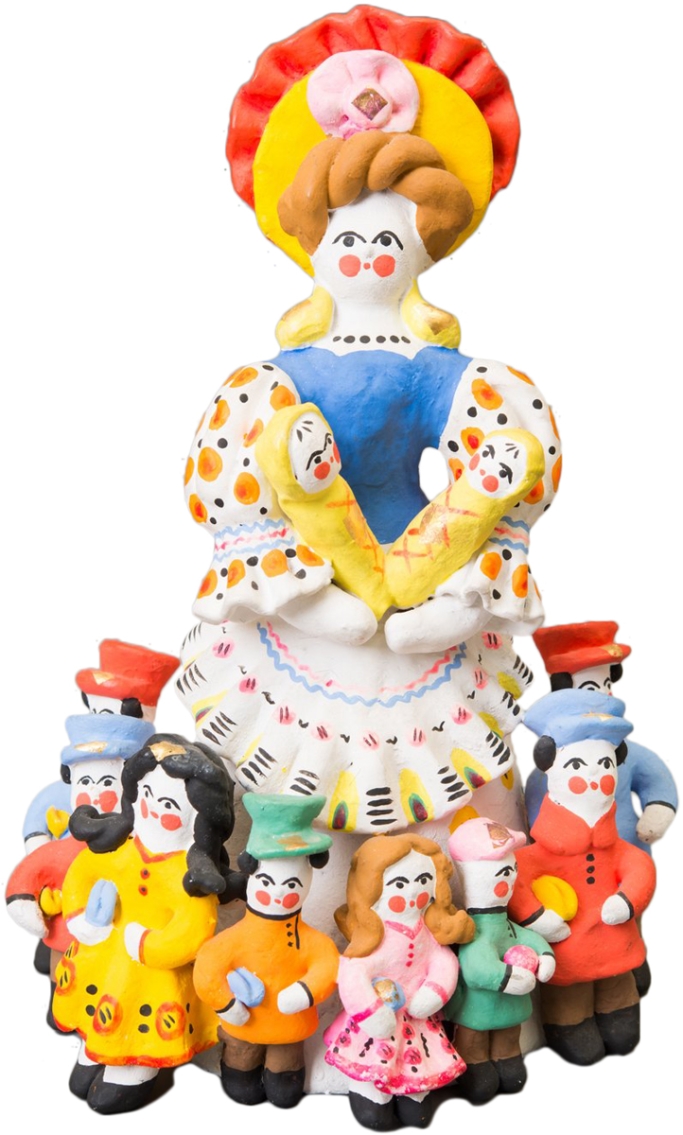
Dymkovo clay doll from Russia, Mother with childrenMother with many children Dymkovo doll, 1960-70s, All-Russian Decorative Art Museum, Moscow

One of the cutest souvenirs one can bring home from Russia is a ceramic folk toy. There is a variety of them but the most lively and most poplar toys are from Vyatka. They are called Dymkovo toys because originally they were produced in Dymkovo Sloboda village. The Dymkovo toy is nearly five hundred years old. The figurines were traditionally made by women and children working together in family units dividing the work according to the skill required for each step. Each person specialized in a particular part of the body or accessories. All parts were joined together and the seams rubbed with a damp rag or a wet finger and then the figures were set aside to dry for several days.

Peranakan beadwork

Peranakan beadwork, detail of tablecloth featuring birds and flowers in its designFragment of a beaded tablecloth, Penang, early 20th century, The Peranakan Museum Singapore 

During my last stay in Singapore a month ago I visited the Peranakan Museum and was really impressed with the amazing examples of Peranakan beadwork. One work was especially memorable: a large (126 x 118 cm) tablecloth made from over a million glass beads, featuring in its design colourful flowers, birds and insects on a turquoise ground. This is the largest known example of Peranakan beadwork in the world. One must visit the museum if only to see this master piece.