 Khokhloma tableware, The Golden Khokhloma Museum, Semyonov
 Souvenirs from Russia: Khokhloma
Khokhloma tableware, The Golden Khokhloma Museum, Semyonov Japanese hand embroidery

photo source
Until 1980, when pieces of Japanese embroidery were exhibited at the national seminar of the Embroiderers' Guild of America in DalIas, Texas, its embroidery was hardly known outside Japan. One of the things that makes Japanese embroidery unique is the fact that it uses silk threads that come in up to 500 different colors. The pattern, the season and the age group of the person who will use the finished product all come into consideration when choosing the right colors.
Souvenirs from Vietnam: embroidery

If you want to bring a meaningful and beautiful souvenir from Vietnam think about buying an embroidered picture. They are rather costly but one doesn't expect a piece of art to be cheap and those embroideries are indeed works of art. There are many motifs to choose from: animals and still life, landscapes and Vietnamese countryside, portraits and flowers.
Made for Maharajahs: the pearl carpet of Baroda

The most incredible carpet ever created by human hand is the famous Pearl Carpet of Baroda. It gets its name from the Maratha Princely State of Baroda, one of the four Princely States of the Maratha Confederacy, that was ruled by the Gaekwar dynasty since 1740. The carpet was made in 1865 and it took embroiderers and jewelers more than three years to create this masterpiece. The then Maharajah of Baroda, Gaekwar Khande Rao, ordered the carpet to fulfill his vow to cover the tomb of the Prophet Muhammad at Medina.
Folk clay toys from Russia
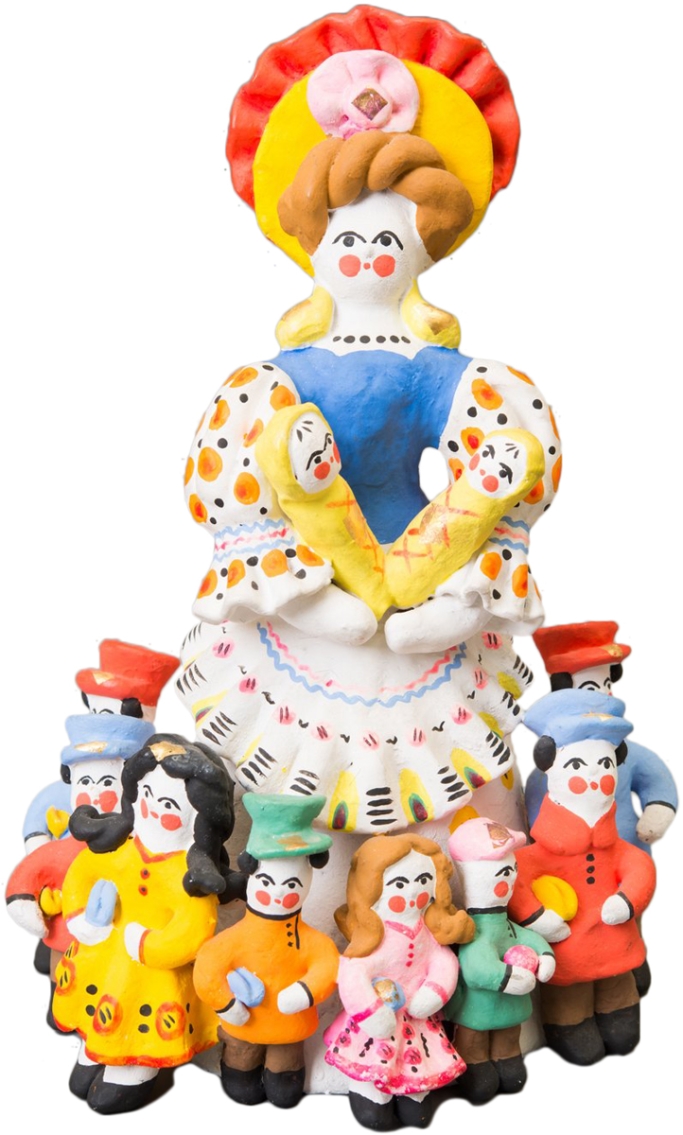 Mother with many children Dymkovo doll, 1960-70s, All-Russian Decorative Art Museum, Moscow
Peranakan beadwork
 Fragment of a beaded tablecloth, Penang, early 20th century, The Peranakan Museum Singapore
 Souvenirs from Vietnam: pottery

Though not famous for its high quality, Vietnam ceramics nevertheless are creative and have a sort of rustic beauty different from that of the carefully refined ceramics from some other countries. There is an air of innocent carelessness about them as if the craftsmen who produced them were quite liberal in their creation not relying too much on the rules of symmetry and decoration.
Subscribe to:
Posts (Atom)