Japanese hand embroidery

Japanese embroidery, obi
photo source

Until 1980, when pieces of Japanese embroidery were exhibited at the national seminar of the Embroiderers' Guild of America in DalIas, Texas, its embroidery was hardly known outside Japan. One of the things that makes Japanese embroidery unique is the fact that it uses silk threads that come in up to 500 different colors. The pattern, the season and the age group of the person who will use the finished product all come into consideration when choosing the right colors.

Souvenirs from Vietnam: embroidery

Vietnamese embroidered picture

If you want to bring a meaningful and beautiful souvenir from Vietnam think about buying an embroidered picture. They are rather costly but one doesn't expect a piece of art to be cheap and those embroideries are indeed works of art. There are many motifs to choose from: animals and still life, landscapes and Vietnamese countryside, portraits and flowers.

Made for Maharajahs: the pearl carpet of Baroda

pearls and other precious stones encrusted carpet of the Maharajah of Baroda India

The most incredible carpet ever created by human hand is the famous Pearl Carpet of Baroda. It gets its name from the Maratha Princely State of Baroda, one of the four Princely States of the Maratha Confederacy, that was ruled by the Gaekwar dynasty since 1740. The carpet was made in 1865 and it took embroiderers and jewelers more than three years to create this masterpiece. The then Maharajah of Baroda, Gaekwar Khande Rao, ordered the carpet to fulfill his vow to cover the tomb of the Prophet Muhammad at Medina.

Folk clay toys from Russia

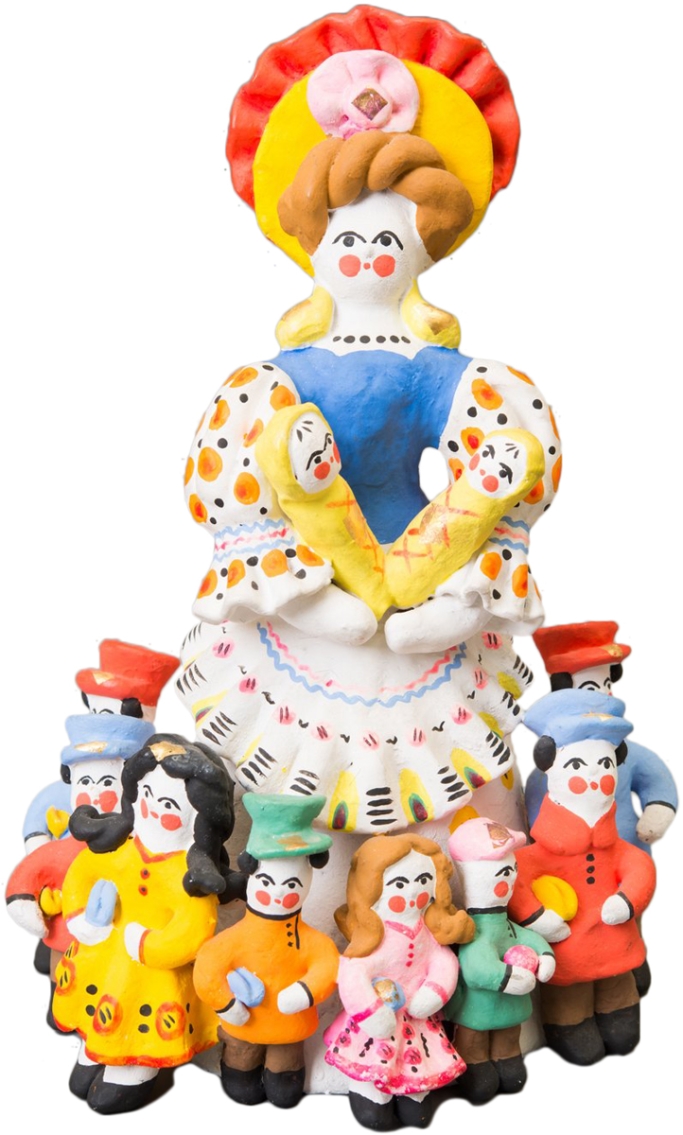
Dymkovo clay doll from Russia, Mother with childrenMother with many children Dymkovo doll, 1960-70s, All-Russian Decorative Art Museum, Moscow

One of the cutest souvenirs one can bring home from Russia is a ceramic folk toy. There is a variety of them but the most lively and most poplar toys are from Vyatka. They are called Dymkovo toys because originally they were produced in Dymkovo Sloboda village. The Dymkovo toy is nearly five hundred years old. The figurines were traditionally made by women and children working together in family units dividing the work according to the skill required for each step. Each person specialized in a particular part of the body or accessories. All parts were joined together and the seams rubbed with a damp rag or a wet finger and then the figures were set aside to dry for several days.

Peranakan beadwork

Peranakan beadwork, detail of tablecloth featuring birds and flowers in its designFragment of a beaded tablecloth, Penang, early 20th century, The Peranakan Museum Singapore 

During my last stay in Singapore a month ago I visited the Peranakan Museum and was really impressed with the amazing examples of Peranakan beadwork. One work was especially memorable: a large (126 x 118 cm) tablecloth made from over a million glass beads, featuring in its design colourful flowers, birds and insects on a turquoise ground. This is the largest known example of Peranakan beadwork in the world. One must visit the museum if only to see this master piece.

Souvenirs from Vietnam: pottery

Vietnamese ceramics for sale in Hoi An

Though not famous for its high quality, Vietnam ceramics nevertheless are creative and have a sort of rustic beauty different from that of the carefully refined ceramics from some other countries. There is an air of innocent carelessness about them as if the craftsmen who produced them were quite liberal in their creation not relying too much on the rules of symmetry and decoration.

Gem carved sculptures from Hoi An museum

Happy Buddha carved from garnet
Happy Buddha, garnet

On a picturesque and crowded with tourists street of the Ancient Town of Hoi An there is a small but interesting museum, the Gemstones Art Museum. It was founded in 2013 by a Vietnamese passionate collector. The museum's exhibition is divided into two sections: one showcases natural gemstone crystals and uncut stones and at another more than two hundred pieces of precious stone sculpture are displayed. In terms of quality and rarity of the stones, the variety of the carvings represented the collection has no comparison in Vietnam. Visitors have a unique chance to get to know and enjoy the great artistic and manual skills of Vietnamese craftsmen. Here are a few examples of the gem carving from the museum's collection