African textiles: the kente, royal cloths of the Ashanti

Ashanti Kente Cloth featured in "Measure of Earth: Textiles and Territory in West Africa", Gregg Museum of Art & Design

These colourful strip-woven cloths are the most recognizable of all African textiles. They are known by the name kente and their creators are the Ashanti, an ethnic group native to the Ashanti Region of modern-day Ghana. The term kente is not used by the Ashanti themselves, but may have come from the word kenten meaning "basket". It refers to the checkerboard appearance of the cloths. According to legend the first weaver learnt his skill by studying the way in which a spider - a symbol of treachery and wisdom in Ashanti folklore - spun its web.

African textiles: the bogolanfini, mud cloths of Mali

African textile, bogolanfini or mud cloth
Bogolanfini, The British Museum

One of the best-known types of textile from Africa, along with the Kente, is the bogolanfini, the cloth of the Bamana people from Mali in West Africa. This distinctive fabric features variety of wavy lines, circles, chevrons, spots and other geometric figures in white on a black background. But this is not the only thing that makes this textile so unique and interesting. Bogolanfini translates from the Bamana as "mud cloth" and indeed, the main and most important element of the bogolan cloth's production process is mud. But it's not any ordinary mud you can find around the corner. The mud used for bogolanfini making is collected from the very deepest sections of the ponds which become exposed for a few months at the height of the dry season. This mud then is left in a covered pot for about a year, during which time it darkens.

African masks

African wooden mask decorated with cowrie shells and beads
Bangende mask. Cotton, cowrie shell, beads, raffia, wood 
 Democratic Republic of Congo. From the collection of the Horniman Museum 

The only time I had a chance to have a closer look at African masks was during my visits to the British and Horniman Museums in London. The masks definitely left a strong impression on me...some looked really scary, some were beautiful in their own unique way and others struck with skillfulness and complexity of handicraft work. African masks are not something you can easily forget once you have seen them. Sometimes masks are a realistic representation of the human or animal head but more often they are carved in an exaggerated or distorted way designed to suggest a supernatural presence.

Gilded gods: the metal craft of Nepal

God Shiva metal sculpture in Basantapur, Nepal

In every temple, every monastery in Nepal as well as in many private home shrines you will find at least one metal statue of a Hindu or Buddhist deity. These statues vary in size - from a few inches to as tall as 12 feet - but any of them will strike you with beauty, facial expression and exquisite detailed work. Most of them are made from copper, sometimes from bronze or brass and usually gilded (with gold in its purest 24 carat form because gods and deities deserve the best after all), sometimes painted and additionally embellished with semi-precious stones. The earliest extant Nepali cast-copper sculptures date to the 6-8th century. Little has changed since that time as Nepalese artisans has kept the craft alive passing the skills from generation to generation.

Traditional handmade toys of India


Toys are the simplest souvenirs that one can bring from India. They are light and small, so will not take much space in the suitcase; they are handcrafted; they are unique and have strong Indian identity; they are beautiful. And it doesn't matter what part of the country you visit because every region has its own distinctive tradition of toys.

Chikan embroidery of Lucknow

Indian chikankari embroidery

The chikan or chikankari is a delicate and subtle embroidery done in white thread on a white background, though sometimes yellowish silk is also used in addition to the white thread. The embroidery is characterized by the contrasts in texture provided by the delicacy of fine jali work and heavily embossed stitches on fine fabrics. It is amazingly beautiful with its delicate patterns and the excellence of execution. Noor Jehan, wife of the Mughal emperor Jehangir is said to have introduced it to Lucknow. The earliest samples of chikan embroidery that have survived are from the 19th century. It is not clear where the word chikan came from. It might come from Persian where it means "embroidery", or it could be of Bengali origin where it means "very fine thing".

Traditional Chinese embroidery

19th century Chinese embroidered silk gauze
Mirror Case with Lunar Scene, Qing dynasty, 19th century. Embroidered silk gauze. The Metropolitan Museum of Art

Embroiery in China has a long history dating back to the invention of silk four thousand years ago. It is known that the ceremonial garments of the tribal leaders of that time were decorated with embroidered patterns of the sun, the moon, stars, weed, fire and other auspicious symbols.
To date the earliest survived embroidery works are the two 4th century BC pieces unearthed from the Chu Tombs. The patterns of dragon, phoenix, tiger and beast embroidered on silk appear natural and lifelike which gives full credit to the achivements of embroidery art in the ancient China.
The art of embroidery further developed during Qin and Han dynasties. Embroideries of that time represent the artistic style as well as the high level of embroidery and mostly have patterns of ripple-like clouds, soaring phoenix, galloping holy beasts, ribbon-shaped flowers, geometric figures etc, using basically locking method with neat stitching, compact compostion and smooth lines.

Souvenirs from Russia: Khokhloma

Khokhloma tableware Khokhloma tableware, The Golden Khokhloma Museum, Semyonov 

I believe almost every family in Russia owns at least a couple of wooden wares - spoons, or bowls, or maybe plates - painted in the so-called Khokhloma style. These simple utensils coloured with images of grass, berries, flowers and leaves in red, gold and black look really impressive and beautiful. This folk art dates back to the 17th century and is named after the village Khokhloma on the Uzola River in the Nizhniy Novgorod region. One of the distincitive features of the Khokhoma style is the characteristic gold-ish colour which is created without applying real gold. The technique is very peculiar: first the unpainted wooden article is coated with special priming, then with drying oil and a thin layer of aluminium powder. The "silvered" object is then painted with heat-resistant oil, varnished and fired. The gold colour appears during this final stage, when the article is kept in a kiln at up to 90C.

Japanese hand embroidery

Japanese embroidery, obi
photo source

Until 1980, when pieces of Japanese embroidery were exhibited at the national seminar of the Embroiderers' Guild of America in DalIas, Texas, its embroidery was hardly known outside Japan. One of the things that makes Japanese embroidery unique is the fact that it uses silk threads that come in up to 500 different colors. The pattern, the season and the age group of the person who will use the finished product all come into consideration when choosing the right colors.

Souvenirs from Vietnam: embroidery

Vietnamese embroidered picture

If you want to bring a meaningful and beautiful souvenir from Vietnam think about buying an embroidered picture. They are rather costly but one doesn't expect a piece of art to be cheap and those embroideries are indeed works of art. There are many motifs to choose from: animals and still life, landscapes and Vietnamese countryside, portraits and flowers.

Made for Maharajahs: the pearl carpet of Baroda

pearls and other precious stones encrusted carpet of the Maharajah of Baroda India

The most incredible carpet ever created by human hand is the famous Pearl Carpet of Baroda. It gets its name from the Maratha Princely State of Baroda, one of the four Princely States of the Maratha Confederacy, that was ruled by the Gaekwar dynasty since 1740. The carpet was made in 1865 and it took embroiderers and jewelers more than three years to create this masterpiece. The then Maharajah of Baroda, Gaekwar Khande Rao, ordered the carpet to fulfill his vow to cover the tomb of the Prophet Muhammad at Medina.

Folk clay toys from Russia

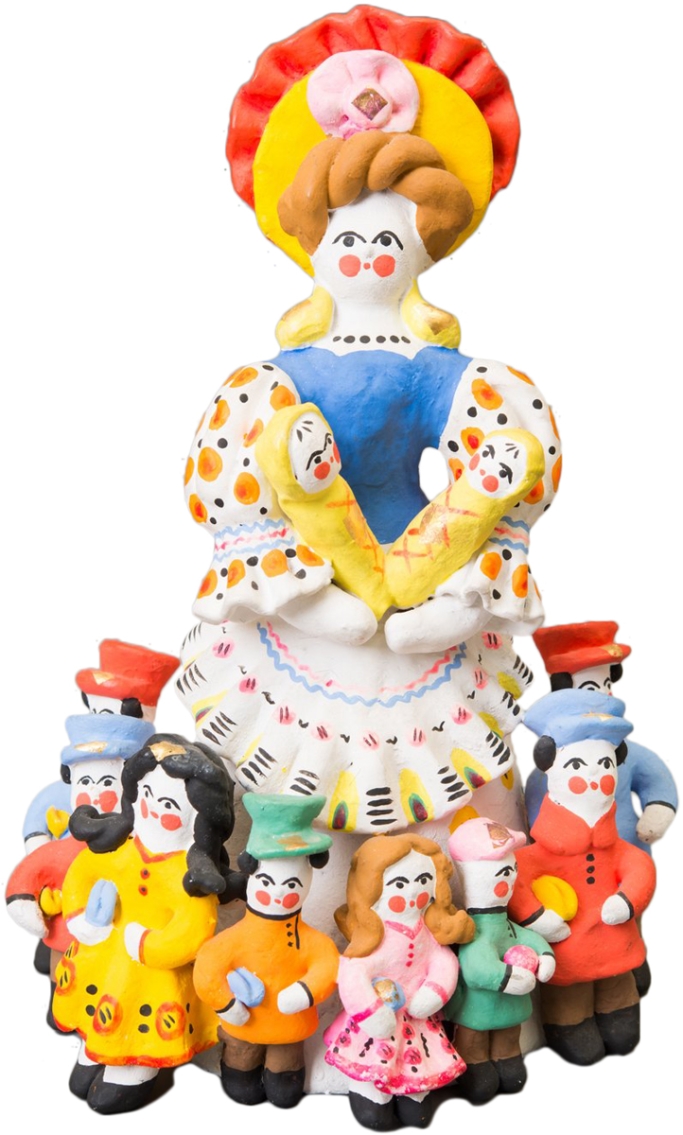
Dymkovo clay doll from Russia, Mother with childrenMother with many children Dymkovo doll, 1960-70s, All-Russian Decorative Art Museum, Moscow

One of the cutest souvenirs one can bring home from Russia is a ceramic folk toy. There is a variety of them but the most lively and most poplar toys are from Vyatka. They are called Dymkovo toys because originally they were produced in Dymkovo Sloboda village. The Dymkovo toy is nearly five hundred years old. The figurines were traditionally made by women and children working together in family units dividing the work according to the skill required for each step. Each person specialized in a particular part of the body or accessories. All parts were joined together and the seams rubbed with a damp rag or a wet finger and then the figures were set aside to dry for several days.

Peranakan beadwork

Peranakan beadwork, detail of tablecloth featuring birds and flowers in its designFragment of a beaded tablecloth, Penang, early 20th century, The Peranakan Museum Singapore 

During my last stay in Singapore a month ago I visited the Peranakan Museum and was really impressed with the amazing examples of Peranakan beadwork. One work was especially memorable: a large (126 x 118 cm) tablecloth made from over a million glass beads, featuring in its design colourful flowers, birds and insects on a turquoise ground. This is the largest known example of Peranakan beadwork in the world. One must visit the museum if only to see this master piece.

Souvenirs from Vietnam: pottery

Vietnamese ceramics for sale in Hoi An

Though not famous for its high quality, Vietnam ceramics nevertheless are creative and have a sort of rustic beauty different from that of the carefully refined ceramics from some other countries. There is an air of innocent carelessness about them as if the craftsmen who produced them were quite liberal in their creation not relying too much on the rules of symmetry and decoration.

Gem carved sculptures from Hoi An museum

Happy Buddha carved from garnet
Happy Buddha, garnet

On a picturesque and crowded with tourists street of the Ancient Town of Hoi An there is a small but interesting museum, the Gemstones Art Museum. It was founded in 2013 by a Vietnamese passionate collector. The museum's exhibition is divided into two sections: one showcases natural gemstone crystals and uncut stones and at another more than two hundred pieces of precious stone sculpture are displayed. In terms of quality and rarity of the stones, the variety of the carvings represented the collection has no comparison in Vietnam. Visitors have a unique chance to get to know and enjoy the great artistic and manual skills of Vietnamese craftsmen. Here are a few examples of the gem carving from the museum's collection

Crafts of Central Asia: ganch carving

Detail of the ganch wall decoration, the Throne Hall, Khudoyar Khan Palace, Kokand, Uzbekistan 

Anyone who has not been to Central Asia is hardly likely to know the meaning of ganch. If one explains what ganch is it may seem highly prosaic: it is neither stone nor clay but something in between. It is obtained by firing a rock containing gypsum and clay and grinding it into a powder which is then mixed with water and a solution of vegetable glue. It then slowly solidifies as it dries out. Its shades range from light gray to light yellow. Ganch carving is one of the unique and ancient forms of artistic crafts of Central Asia.

Crafts of Russia: wedding ring shawls of Orenburg


Orenburg shawls are one of the world famous symbols of Russia. These lacy hand-knitted pieces of art are beautiful, warm and so light, fine and delicate that can be pulled through a wedding ring. They are so loved in Russia that there is even a song dedicated to this piece of clothing.

Tonight, when there's frost and there's blizzard
When the snow storm is roaming the road
Will you cover my shoulders, sweet darling,
With an Orenburg downy shawl.

The story of the Orenburg shawl started in the second half of the 18th century, when two older crafts were joined together. One of the predecessors of the fluffy shawl with its cobweb pattern was the thermal Kalmyk or Cossack shawl, which was worn under light clothing in fierce frosts, and knitted in plain stitch from the softest goat's fleece. The other was the fine lace shawls made by Ural Cossack women.

Crafts of Burma: kalaga wall hangings

 Kalaga wall hanging depicting peacocks
Late 19th century kalaga wall hanging; embroidered wool with silver and gilt threads and sequins, with appliqué of coloured braids, silk and felt fabrics, padded. The Victoria and Albert Museum

Kalagas are traditional beads and metal-thread embroidered pictures that originally were used to decorate the walls of the palaces and the temples, served as a room partitions or as screens hung outside the house on festive occasions. The word "kalaga" literally means "foreign certain" and referrs to the fact that the original idea was imported from Thailand. The art has been practised in Myanmar for well over two hundred years. Kalagas's most distinctive feature is richly decorated, applique figures that are padded to give a soft relief on an ornamented background.

Crafts of Belarus: Sluck sashes


Double-sided sash, Sluck, 1778-1807, silk weaving. Photo source

Being a bit nostalgic about the days I spent in Belarus recently I decided to write about something Belurusian. And there can not be a better choice than Sluck sashes , real treasure of Belarusian culture. This type of handwork was produced in Belarus (then Rzeczpospolita) in the second half of the 18th and early 19th centuries. Sluck sashes were named after the city of Slutsk (Minsk region), where they were first produced in 18th century to replace expensive imported sashes from the Orient. Such sashes from Ottoman Empire, Persia, Iran and China were very popular among the nobles of the time and served not only as a decorative element of the costume but as a symbol of high social status and wealth as well.

Traditional masks of Nepal

Traditional Nepalese mask

Traditional masks of Nepal can be devided into two sorts: "tribal" masks which belong to the ethnic groups such as Gurung, Magar, Tharu, Rai etc and which are also referred to as "shaman's" masks; and "classical" masks which represent Hindu and Buddhist gods and goddesses.
The classical Nepali masks always represent deities or demons and never the dead or the ancestors. Besides, masks are more often used in processions and in rituals rather than in theatrical performances.
There are three categories of masks: first, masks representing faces of gods which are worn by performers during ritual dances, a second category, masks which serve as ornamental motifs for decorating a temple, a chariot during a procession or a vase used as a ritual object. A third category includes masks in metal or stone representing faces of deities that are worshiped like statues. They are called statue-masks. The metal used for making them are silver, brass or bronze. These masks are often decorated with jewels and when not worshiped they are kept in a wooden box inside the temple.